Rotary Seals

Sealing Technology for Rotating Shafts
Rotary Seals for Dynamically Loaded Systems
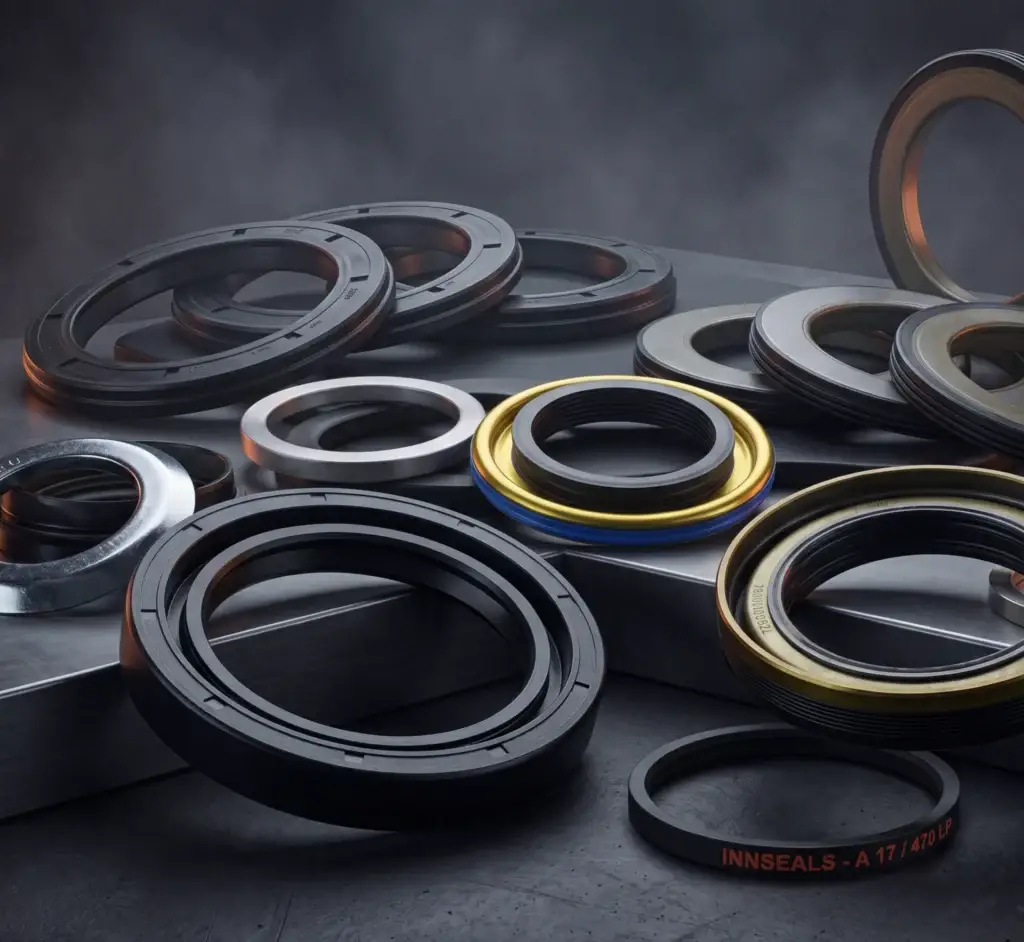
Rotary seals are used to seal rotating shafts and dynamically loaded components. Depending on the application, they must reliably manage friction, wear, pressure, speed, temperature and media compatibility. INNSEALS offers rotary seals for a wide range of industrial requirements – from standard rotary shaft seals and high-performance rotary shaft seals to PTFE rotary seals, high-pressure rotary shaft seals, gamma seals, V-rings and other specialty solutions.
The Right Rotary Seal for Your Application
We provide personal consulting
Send us your inquiry with details of the dimensions, material, medium, temperature range, speed, pressure and installation situation. Our team will assess which rotary seal is suitable for your application.
Which Rotary Seals Does INNSEALS Offer?
Rotary seals seal moving systems in which shafts, housings or other components rotate. Depending on the application, different designs are used: standard rotary shaft seals for classic shaft sealing, high-performance rotary shaft seals for heavy-duty applications, high-pressure rotary shaft seals for pressure-loaded systems or PTFE rotor seals for chemically demanding media.
The right selection depends on rotational speed, circumferential speed, pressure, temperature, medium, installation space and the surface quality of the shaft. For demanding applications, technical coordination is recommended to ensure that the sealing lip, material and design reliably match the system.
Typical Requirements
- Low Friction
- High Wear Resistance
- Media Resistance
- Pressure Resistance
- Temperature Resistance
- Suitable Rotational Speed and Circumferential Speed
- Suitable Design for Shaft and Housing
Your FAQs answered
Frequently asked questions:
There are various designs, e.g. with or without a dust lip as well as different sealing lip designs. Selection is based on operating conditions such as contamination, pressure and rotational speed.
Typical materials are NBR, FKM or PTFE. They differ in temperature resistance, chemical resistance and wear behavior depending on the application.
Inner diameter, outer diameter and width are important. These dimensions must match the shaft and housing exactly to ensure reliable sealing.
No, shaft seals should generally be replaced after removal. Already used seals may be damaged or worn and may no longer reliably perform their function.
They are robust, versatile and available in many standard sizes. They also offer reliable sealing in rotating applications and are economical to use.